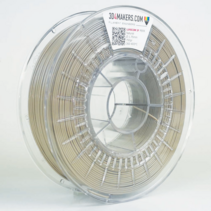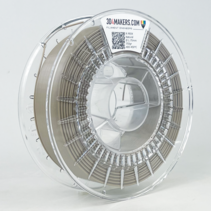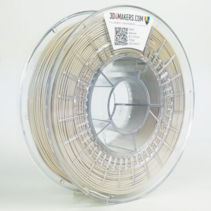

PEKK-A is a polyetherketoneketone (PEKK) filament from the same family of high-performance polyaryletherketones as PEEK. 3D4M makes it from the PEKK 6000 series: an amorphous grade with a slow crystallisation rate, in its medium-flow version. That slow crystallisation gives better bonding between layers in the Z direction, which is where printed parts in this class usually give way first.
The material resists high temperatures and chemicals, is light with high tensile strength, and is inherently flame resistant. Its usual sectors are aerospace, energy and transport. Easier than PEEK still means demanding: PEKK-A is printed on an industrial machine with a heated chamber, and drying is not optional.
Why PEKK-A
Better Z-layer bonding
Amorphous grade with slow crystallisation, more printable than PEEK.
UL 94 V-0 at 0.8 mm
Inherently flame resistant, no additives needed.
158 °C glass transition
Keeps its shape at high temperatures.
88 MPa tensile strength
Light material with high strength (base resin).
FAR 25.853 certified
Suited to applications in aerospace, energy and transport.
Specifications
| Property |
Value |
| Material |
Polyetherketoneketone (PEKK), amorphous, PEKK 6000 series |
| Colour |
Natural |
| Diameter |
1.75 mm or 2.85 mm |
| Spool weight |
200 g, 500 g, 750 g, 1,000 g or 2,000 g |
| Density |
1.27 g/cm³ |
| Glass transition |
158 °C |
| Heat deflection temperature (1.8 MPa) |
139 °C |
| Tensile strength (yield, 23 °C) |
88 MPa |
| Tensile strength (yield, 125 °C) |
53 MPa |
| Tensile modulus |
2.9 GPa |
| Flexural strength |
128 MPa |
| Flexural modulus |
3.0 GPa |
| Flammability |
UL 94 V-0 (0.8 mm), LOI 43% (3.2 mm) |
| Nozzle temperature |
350 to 400 °C |
| Heated bed temperature |
120 to 160 °C |
| Chamber temperature |
70 to 150 °C |
| Print speed |
20 to 40 mm/s |
| Adhesion |
Magigoo HT on carbon plate, PEI sheet or glass |
| Drying |
120 °C, 6 to 8 hours, before printing |
Values are typical values of the base resin, measured on injection-moulded test bars in the amorphous state. They are not measurements of 3D-printed parts. Flammability ratings come from laboratory tests and do not reflect the hazards under actual fire conditions. Source: 3D4M technical data sheet, issued 9 October 2026.